


Breaking Barriers, Inspiring Minds
Rebel
alternative provision
NURTURE-BASED * CREATIVE * ACCREDITED * PERSONALISED *
WELCOME TO REBEL CREATIVE IMPACT HUB
A DIFFERENT ROUTE INTO LEARNING
Rebel Creative Impact Hub is a Swindon Borough Council-approved Alternative Provision provider, offering therapeutic, personalised education for children and young people in Swindon who are unable to attend school full-time.
We believe that every young person can learn, achieve and progress — but not every young person thrives in the same environment. Our nurture-based Alternative Provision creates a safe, creative and personalised space where young people can feel seen, heard, understood and valued. We support young people with a range of SEMH, SEND and complex needs, recognising that behind every referral is a young person with their own story, interests, hopes and aspirations.
We believe every young person deserves a pathway to growth, purpose and potential. Through relationships, creativity and academic learning, we create opportunities for young people to rediscover their confidence, find their voice, reconnect with learning and experience success. We use what matters to each learner as a route into education, helping them recognise their strengths, believe in what they can achieve and take pride in their journey towards their next step.
NURTURE AT THE HEART. CREATIVITY AS THE ROUTE IN.
CREATIVE

NURTURE AT THE HEART. CREATIVITY AS THE ROUTE IN.

OUR APPROACH IN PRACTICE
Our Alternative Education Provision blends specialist student re-engagement with core academic learning, creative education, and emotional wellbeing. We focus on practical skills development and accredited pathways to ensure every learner achieves meaningful, long-term success.

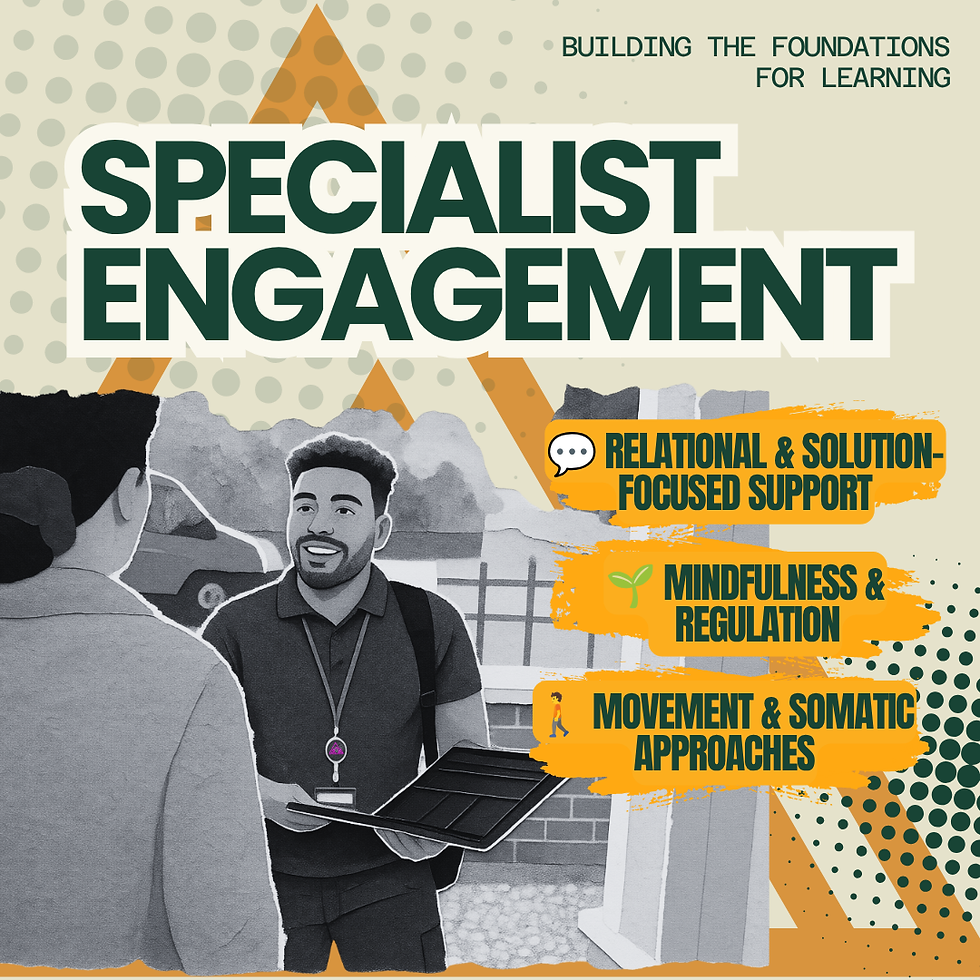


LEARNING THAT STARTS WITH THE LEARNER
We don't expect every learner to fit the same model. We adapt the model around the learner.
Every young person starts from a different place. Our provision is shaped around their individual strengths, interests, needs, experiences, attainment and aspirations, with learning adapted to their readiness and pace.
We take time to understand what may be getting in the way of learning and what can help the young person reconnect with education.
PERSONALISING THE LEARNING JOURNEY
Learning may be adapted around:
-
Individual starting point and attainment
-
Strengths, interests and passions
-
SEND and SEMH needs
-
Communication style and preferences
-
Emotional wellbeing and regulation
-
EHCP outcomes, where applicable
-
Personal goals and aspirations
-
Readiness for different learning environments


For some learners, creativity is the way in. For others, it may be practical learning, movement, a trusted relationship, a particular interest or simply having the time and space to feel safe enough to engage.
From there, we build.
CONNECTION → CONFIDENCE → ENGAGEMENT → LEARNING → PROGRESSION
Our aim is to create the conditions in which young people can experience success, recognise their strengths and gradually develop greater confidence, independence and ownership of their learning.
Learning starts where the learner is — and grows from there.
HOW OUR PROVISION WORKS
A FLEXIBLE STEP UP STEP DOWN MODEL
Not every learner is ready to access the same environment, timetable or level of independence when they first join us.
Our provision uses a flexible step-up, step-down approach, allowing the level of support and learning environment to adapt as a learner's confidence, engagement, needs and readiness develop.
A learner may begin with more intensive 1:1 support and gradually step up into community-based and group learning. Equally, if a learner experiences a period of difficulty, support can step back down to provide greater stability before building up again.

Our provision uses a step-up, step-down approach, allowing support and learning environments to adapt as learners develop confidence, engagement and independence.
1:1 SUPPORT → COMMUNITY → HUB → GROUP LEARNING → EDUCATION / TRAINING / EMPLOYMENT
Learners can move forwards or step back when needed.
THE ENVIRONMENT CAN FLEX — THE RELATIONSHIP STAYS CONSISTENT.

Download Booklet


WHO WE SUPPORT
EVERY LEARNER HAS A DIFFERENT STORY
Rebel Creative Impact Hub supports young people who may be finding mainstream education difficult to access, including those with SEMH, SEND and complex needs.
We recognise that a young person’s needs cannot always be understood through a diagnosis or label alone. We look at the whole learner — their experiences, strengths, communication, relationships, interests, wellbeing, barriers to learning and aspirations.
OUR PROVISION CAN SUPPORT YOUNG PEOPLE WITH:
Neurodivergence & Communication
-
Autistic Spectrum Condition (ASC)
-
ADHD
-
Speech, Language and Communication Needs (SLCN)
-
Communication and social interaction difficulties
SEMH & Emotional Wellbeing
-
SEMH needs
-
Anxiety and school-related anxiety
-
Emotionally Based School Avoidance (EBSA)
-
Emotional regulation difficulties
-
Social and relationship difficulties
-
Mental health and wellbeing needs
Complex & Vulnerable Circumstances
-
Adverse Childhood Experiences (ACEs)
-
Care experience and multiple placement changes
-
Exploitation or increased vulnerability to risk
-
Risk of offending or harmful peer groups
-
Significant disruption to education
-
Persistent non-attendance
Cognition & Learning
-
Specific Learning Difficulties, including dyslexia and dyspraxia
-
Moderate Learning Difficulties (MLD)
-
Gaps in learning or disrupted academic progress
LOOKING BEYOND THE LABEL
A referral tells us something about a young person — but it does not tell us everything about them. We take time to understand what has happened, what matters to them, what they are good at and what they need in order to engage with learning.
This helps us build a personalised pathway that starts from where the learner is, while keeping sight of where they want to go.
OUR LEARNING ENVIRONMENT

92 B Victoria Rd, Swindon SN1 3BD
📍 Location
SMALL BY DESIGN.
BUILT AROUND THE LEARNER.
The environment young people learn in can make a significant difference to how safe, connected and ready to learn they feel.
Our Creative Impact Hub in Old Town, Swindon provides a welcoming, creative and nurturing environment designed to feel different from a traditional classroom.
We keep our provision small by design, allowing us to build strong relationships, understand individual needs and create the space for young people to participate at a pace that works for them.
Our learning environments can provide:
-
Small-group and personalised learning
-
Creative and practical learning spaces
-
Opportunities for movement and regulation
-
A calm, welcoming atmosphere
-
Access to outdoor and community-based learning
-
Opportunities to learn through interests and real-world experiences
-
Trusted relationships with consistent adults
-
Flexible approaches to participation and engagement
LEARNING ACROSS DIFFERENT ENVIRONMENTS
We also use other local spaces to ensure provision can be shaped around individual learners.

HOME OUTREACH
Specialist engagement work can begin in the learner’s home where appropriate, supporting those who may not yet be ready to access a learning environment.
FOCAL POINT
Town centre based, available for 1:1 and small-group learning for learners aged 14+, with disability-accessible facilities.
LOCAL COMMUNTIY VENUES
One-to-one learning can also take place in community centres, libraries or outdoor/nature-based settings closer to where a learner lives.
MEASURING PROGRESS.
Progress looks different for every learner. We establish an individual starting point and set personalised targets based on their needs, strengths and aspirations.
Our review process follows a Plan → Do → Check → Act cycle, allowing us to review progress, adapt support and identify the right next step for each learner.
We review progress across:
-
Attendance and engagement
-
Academic and learning progress
-
Qualification achievement
-
Personal development and independence
-
Emotional wellbeing and confidence
-
Learner voice and feedback
-
Strengths and Difficulties Questionnaire
-
EHCP outcomes, where applicable
-
Learner voice and feedback
We use a combination of professional assessments, learning assessments, attendance data, qualification evidence and appropriate wellbeing and social-emotional measures to build a rounded picture of progress.


REVIEW → ADAPT → RECOGNISE → CHALLENGE → PROGRESS
Initial reviews and ongoing placement evaluations provide opportunities to recognise progress, adapt support and appropriately increase challenge or step down support as learners develop confidence, engagement and independence.
CONTINUOUS IMPROVEMENT
We are committed to continuously reviewing and improving our provision. Feedback from learners, families, schools and professionals, alongside outcomes, attendance, engagement and operational learning, helps us identify what is working, where improvements are needed and how our provision can continue to develop.
Our Evidence-Based Approach
At Rebel, our services are underpinned by relational, trauma-informed and evidence-informed approaches that support emotional regulation, engagement and readiness for learning. Our framework is shaped by leading psychological and educational theories, allowing us to deliver personalised, therapeutic support that meets the unique needs of every learner.
We draw upon the following approaches:
🧠 Nurture Theory
We build safe, trusting relationships that help learners feel secure, valued and ready to engage in learning, including through small nurture-style groups that support emotional wellbeing, confidence and positive relationships.
🎨 Holistic Creative Arts Approach
We use creative approaches such as art, music, movement, drama, storytelling and sensory activities to help learners express themselves, process experiences and build confidence in a safe and supportive way.
🌈 PACE Model
Our approach is built on Playfulness, Acceptance, Curiosity and Empathy, helping learners feel safe, supported and understood while building trust, emotional regulation and motivation to learn.
🌿 Somatic Regulation & Movement Practice
We use movement, breathing, grounding and sensory activities, alongside physical activity, to help learners regulate emotions, feel calm and stay engaged in learning.
💬 Solution-Focused Coaching & Motivational Interviewing
We use approaches such as OARS — Open questions, Affirmations, Reflective listening and Summarising — to help learners build self-awareness, explore their goals and take positive, manageable steps towards change.
🔺 Needs-led Practice
Maslow's Hierarchy of Needs is used as one framework for considering the emotional, relational and practical foundations that may need to be addressed before learners are ready to access more demanding learning.
Our Alternative Provision Principles
Learners are supported according to their developmental stage rather than chronological age or fixed attainment levels. Practice is individualised, non-judgemental and focused on meeting learners where they are, enabling secure foundations for engagement, confidence and progress.
We ground our work in trusted theories like Maslow’s Hierarchy of Needs, Nurture Theory, and coaching models that promote a growth mindset. These shape how we support every learner—personally, socially, emotionally, and academically—ensuring our approach is both meaningful and informed by best practice.
The learning environment provides a stable, safe and supportive base that promotes emotional security and engagement. Trusted adult relationships are central to all provision and support learners to feel safe, valued and ready to learn.
Trusted adults play a vital role in each learner’s journey—offering emotional support, modelling positive behaviour, and fostering a sense of responsibility. Our team blends adaptive teaching, coaching, and pastoral care to build trust and sustained engagement.
We use scaffolding to lay strong foundations: support is high at first, then gradually withdrawn as confidence grows - enabling learners to reach new levels of independence and self-belief.
Language allows us to share our thoughts, exchange ideas, and truly understand one another. It bridges cultures and experiences, helping us collaborate, learn, and build meaningful relationships. We recognise the diversity of how people communicate, especially those who are neurodiverse, and are dedicated to supporting everyone’s unique way of expressing themselves while being mindful of how our words affect others.
Resilience gives young people vital life skills to cope with challenges and adversity—whether unexpected changes, transitions, or emotional triggers. We support their growth through emotional literacy and mindfulness, guiding them to understand and manage their thoughts and feelings while reframing experiences of adversity, conflict, and trauma.

WHERE CAN LEARNING LEAD?
👟 BUILDING TOWARDS THE NEXT STEP
Our aim is to help young people develop the confidence, skills, qualifications and independence they need to move towards their next appropriate step.
Progress looks different for every learner. For some, this may mean reconnecting with education and preparing to return to school. For others, it may mean moving towards further education, training, employment or greater independence.
PROGRESSION CAN INCLUDE:
-
Education — returning to mainstream or another appropriate education setting
-
Further Education — progressing to college or post-16 study
-
Training — accessing vocational learning, apprenticeships or other training opportunities
-
Employment — developing employability skills and preparing for the world of work
-
Independence — building the practical, personal and social skills needed for adult life
-
Community Participation — developing confidence and opportunities to contribute within the wider community.
A PATHWAY WITH PURPOSE
We work with learners, families and referring professionals to identify realistic and meaningful progression goals, building towards them through personalised learning, accredited achievement, personal development and practical experience.
As learners develop confidence, engagement and independence, we can gradually increase challenge, responsibility and ownership of learning.
TESTIMONIALS
WHAT THEY SAY ABOUT US
“They took the time to understand the young person.”
“Rebel took the time to understand the young person as an individual and build a positive relationship with them. Their approach recognised that emotional wellbeing and learning are closely connected, with emotional support and regulation naturally woven into the tuition provision. Learning was personalised around the young person’s interests, needs and individual pace, helping them to gradually develop their confidence, engagement and willingness to participate.”
Social Worker
“They found creative ways to remove barriers.”
“Rebel took the time to build a trusting relationship and work at the young person’s pace. Their patience and flexibility helped him gradually move from learning in the care home to accessing the community and educational activities. They found creative ways to remove barriers to learning, including using his interest in technology to develop literacy and ICT skills. We saw a real increase in his confidence, engagement and willingness to participate.”
Registered Manager at Brighter Beginnings Registered Children’s Residential Home
“He went from saying he hated English to finding his voice.”
“When he first started with Rebel, he told us he hated English. They found a way to make learning relevant to him through his love of rap and music. His confidence and engagement have grown, and he is now writing his own lyrics, exploring different creative ideas and developing his skills. He is working towards his Arts Award Silver and is soon to achieve a Level 2 qualification. It’s been amazing to see him turn something he loves into something he can achieve through.”
Parent of Year 12 Student
READY TO EXPLORE A PLACEMENT?
LET’S TALK ABOUT WHAT YOUR LEARNER NEEDS
If you’re a school, local authority or professional looking for Alternative Provision, we’d be happy to talk through the young person’s needs, interests, current situation and potential pathway.
We can discuss:
-
The learner’s individual needs and starting point
-
Suitable learning and support options
-
Academic and accredited learning pathways
-
The right environment and level of support
-
Progression goals and next steps